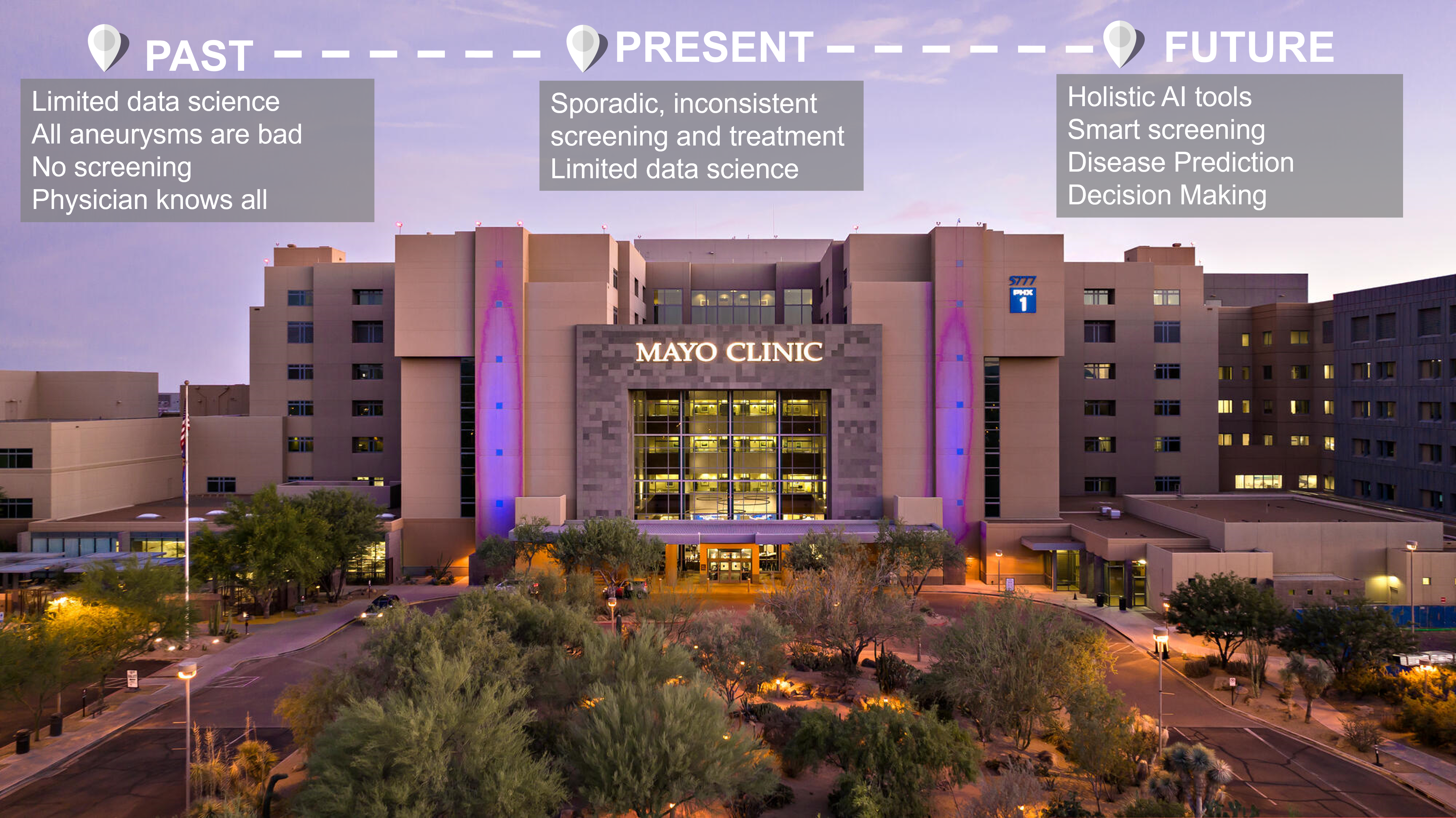
In the ever-evolving landscape of medical technology, machine learning (ML) is taking center stage in transforming how we approach healthcare. Among many, one of the most promising neurosurgical applications of ML is in the prediction of rupture risk of intracranial aneurysms. The importance of accurate rupture risk prediction becomes evident when considering the significant risks of both undertreatment and overtreatment of unruptured aneurysms. In an ideal world, we aim to treat those aneurysms that are destined to rupture with as little procedural risk as possible.
Traditionally, predicting the risk of aneurysm rupture has relied heavily on expert opinion, a series of imperfect natural history studies, and the now well embraced PHASES score. These predictions often involve evaluating a range of factors, including the size, location and shape of the aneurysm, the patient’s age, family history and lifestyle choices such as smoking. While these methods have been effective, they are not without limitations. Human error, the subjectivity of risk evaluation and the complexity of interpreting vast amounts of patient data have all posed challenges in achieving consistently accurate predictions. Meanwhile, the entrance of ML into the clinical setting has led to significant changes in the field of medical diagnostics. By leveraging vast datasets and complex algorithms, ML models enable clinicians to analyze patterns that might elude even the most experienced clinicians.
Since 2018, the integration of ML into clinical practice with the aim of predicting aneurysmal rupture risk has gained momentum. By the end of 2023, more than 35 studies focused on applications of ML for aneurysm rupture risk assessment were published. A dive into this literature reveals the breadth of computational techniques being explored with more than 120 ML models developed and tested. Among these models, for example, are algorithms developed for prediction of the likelihood of an aneurysm rupture based on imaging data alone. These models analyze features such as wall shear stress and aneurysm wall thickness—factors that traditional evaluative methods might overlook or not fully incorporate into risk calculations. The potential of ML-based risk prediction is further supported by our recent unpublished meta-analysis, which reveals the high sensitivity and specificity of ML models, surpassing that of the PHASES score.
The impact of ML on aneurysm risk prediction extends beyond enhancing accuracy and consistency. It also has the potential to democratize access to high-quality care. In regions where specialists in vascular diseases are scarce, ML tools can assist general practitioners in making informed decisions about patient care, ensuring that those with high risk of aneurysm rupture receive timely, appropriate referral and possible intervention.
Despite its growing potential, the integration of ML into clinical practice is not without its challenges. There are concerns about the transparency of ML models, often referred to as the “black box” problem, in which the ML decision-making process is not easily understood by clinicians. Additionally, the well-known issue of overfitting, where a model performs well on training data but fails to generalize to new data, continues to pose a significant challenge in the development of highly generalizable ML models. Regardless, the evolution of ever more efficacious and specified solution suggests a promising future in ML driven aneurysm risk prediction. Ongoing research and collaboration between ML developers and medical professionals is driving continuous improvements in the accuracy, reliability and usability of these tools. As ML becomes more integrated into the healthcare system, it holds the promise of saving countless lives by providing earlier and more accurate identification of patients at risk of aneurysm rupture.
In summary, recent growth in technological development and collaborative problem solving has advanced the field of ML to the precipice of revolutionizing the way clinicians approach aneurysm risk prediction. By enhancing the accuracy and consistency of risk assessments, these technologies are set to become invaluable tools in the fight against this silent but deadly condition. As the data science and medical communities continue to explore the full potential of ML, patients and healthcare providers alike can look forward to a future where ML serves as a useful tool to enhance neurosurgical outcomes across the board.


S. Farzad Maroufi MD, MPH, MPHE
S. Farzad Maroufi is an MD-MPH-MPHE graduate from Tehran University of Medical Sciences. He has been a doing neurosurgical research for the past 7 years with more than 70 papers. Currently, he is a member of Neurosurgical Simulation and Innovation lab under Dr. Bendok’s supervision.

Vita Olson, BA
Vita Olson is a Research Assistant in the Neurosurgery Simulation and Innovation Lab at Mayo Clinic Arizona and graduate of the University of San Diego.

Evelyn Turcotte is a third-year medical student from Mayo Clinic Alix School of Medicine and researcher within the Neurosurgical Simulation and Innovation Lab at Mayo Clinic, Arizona.

Chandan Krishna, MD
Dr. Chandan Krishna is the Associate Program Director of the Department of Neurological surgery at Mayo Clinic-Arizona. He additionally is a member of the Neurosurgery Simulation and Innovation Laboratory at Mayo Clinic. He completed his neurosurgical residency at Houston Methodist hospital with a subsequent endovascular fellowship at the University of Buffalo. His current practice involves the surgical treatment of complex cranial, cerebrovascular and spine pathology.

Hunt Batjer, MD
Dr. Hunt Batjer is Professor Emeritus and the past Lois C.A. and Darwin E. Smith Distinguished Chair in Neurological Surgery and Chair of the Department of Neurological Surgery at the University of Texas Southwestern Medical Center in Dallas. He is also an Adjunct Professor of Neurosurgery at the Mayo Clinic College of Medicine and Science. He recently accepted the position as Professor of Neurosurgery and Director of Neuroscience Education and Research at UT Tyler School of Medicine. He is recognized internationally as a leading cerebrovascular surgeon. His academic pursuits and research in ischemic and hemorrhagic stroke and brain injuries have resulted in more than 500 peer-reviewed publications and book chapters, as well as 9 books.

Dr. Bernard R. Bendok is the Chair of the Department of Neurologic Surgery, residency program director, and directs fellowships in vascular neurosurgery and skull base surgery at Mayo Clinic in Arizona. He additionally co-directs the Precision Neurotherapeutics Laboratory and the Neurosurgery Simulation and Innovation Laboratory. He specializes in complex neurovascular and skull base brain pathologies, brain tumors, acoustic neuromas and pituitary tumors. He is grateful for the unique and inspirational mentorship he has received from Hunt Batjer and Nick Hopkins. He is most proud of his two children and of all the clinical and research mentees he has had the privilege to associate with.