
Imagine a scenario where you are having the kitchen redone in your home. You have selected all new appliances and all new cabinets. You secure a bid from a contractor, agree on an estimate, and the contractor completes the agreed upon work. As expected, after completing the project, the contractor sends you a bill. All of the items on the invoice accurately represent the work that was completed. For the purposes of discussion, assume the cost is $25,000 (fictional number). As anyone in any industry would expect, you pay the bill. That’s how the world works.
Contrast this scenario with the world of medicine and neurosurgery in particular. Continuing with the home improvement scenario, months later, you hire the same contractor to build an addition on your house. The process of a bid, estimate and work is repeated. But this time around, you send the contractor a little note stating that you want proof that all the appliances he installed for the kitchen remodel months ago were in fact the appliances you purchased. You mention in your note that failure to comply with your request will invalidate all the work performed in the kitchen. Let’s also assume the contractor never sees the note that you sent via the U.S. Postal Service because their business is almost exclusively electronic communication. Just like everything else these days. Your letter was left unopened among the stacks of junk mail. Let’s assume the cost of the addition to the house is $100,000. When it comes time to pay for the completed work on the addition, you pay the amount on the invoice but subtract the entirety of the amount you paid from the kitchen remodel. You write a check for $75,000. The letter overlooked by the contractor just saved you but cost the contractor a lot of money. To review, it was the contractor’s fault that the letter remained unopened; had the contractor responded to your notice, you would have paid the full $100,000. The lost revenue is the contractor’s fault not yours.
One problem with the scenario above: that’s not how the real-world works…unless you are a neurosurgeon. In the real world, the contractor would put a lien on your house until the balance was fully paid. When a recovery of a payment happens in neurosurgery, we shrug our shoulders and knock on the door of the next patient that needs our help. There is almost a level of acceptance or learned helplessness. Of course, assuming that we are even aware of what happened. The reality is that the majority of these recoupments go unnoticed. Their stealth existence is surely part of their design.
While the home improvement scenario above is outlandish and unthinkable in the real world of business, it is commonplace in medicine. What I have described is the practice of recoupment which benefits commercial insurers by tens of millions of dollars each year. Let me provide the reader with a real-world example.
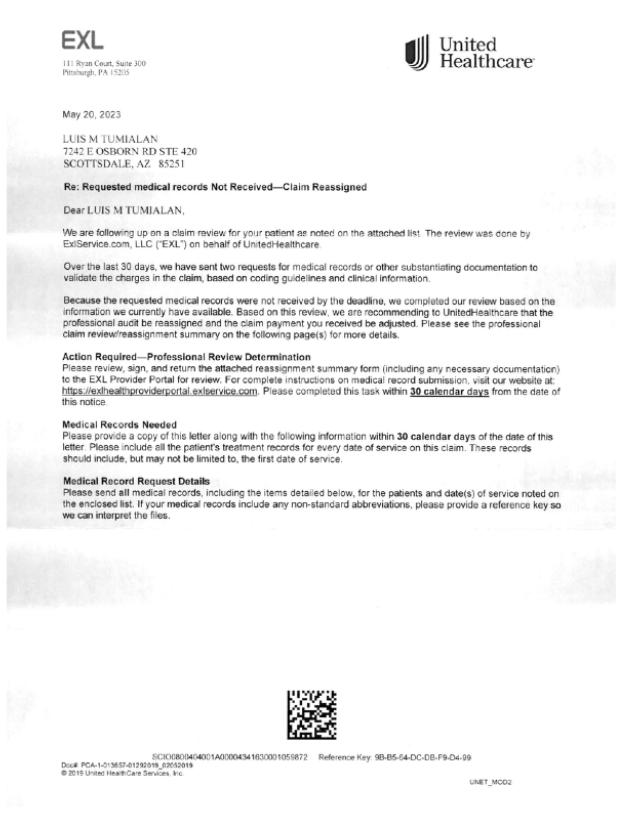
In December 2022, I performed a two-level ACDF on a patient with cervical myelopathy. A prior authorization was obtained, and the procedure performed matched the codes on the prior authorization. After a successful operation, the patient recovered with clinical and radiographic evidence of healing. At the three-month mark, the commercial payer paid the agreed-upon contractual rate for the procedure performed. The business office marked the account “paid in full.” Three months after the procedure, the commercial payer had a third-party company send me a note through the USPS requesting the entirety of the medical record. The commercial payer had tasked a third party with ensuring that the procedure billed matched the procedure performed. Unfortunately, the note went unnoticed because 98 percent of communication is electronic in 2024. Eight months after the procedure was performed, the commercial payer subtracted the entirety of the initial payment from a subsequent payment made for other patients. The sequence of events I describe above is known as a recoupment. The absence of response from my practice resulted in what the industry calls a technical denial. Over the span of three years, technical denials resulted in loss of over $1.7 million dollars to a 27-neurosurgeon group. Tragically, that number may be significantly underestimated.
The recoupment is a perfect grenade to disrupt accounts receivable even in the most sophisticated of business offices. After all, the account appears paid in full until the recoupment occurs. Essential to efficacy of the recoupment is how inconspicuous subtraction from a subsequent payment can be. The loss of revenue is, at first, almost imperceptible. After all, the business office has a check in their possession. The amount of that check represents the payments of dozens of patients over an extensive period. The amount can be sizable. Subtracting one payment from such a large sum can require quite of bit of unravelling by the business office to link it to the closed account that was at one time paid in full. Tragically, the recoupment can go unnoticed unless the business office is aware of the tactic.
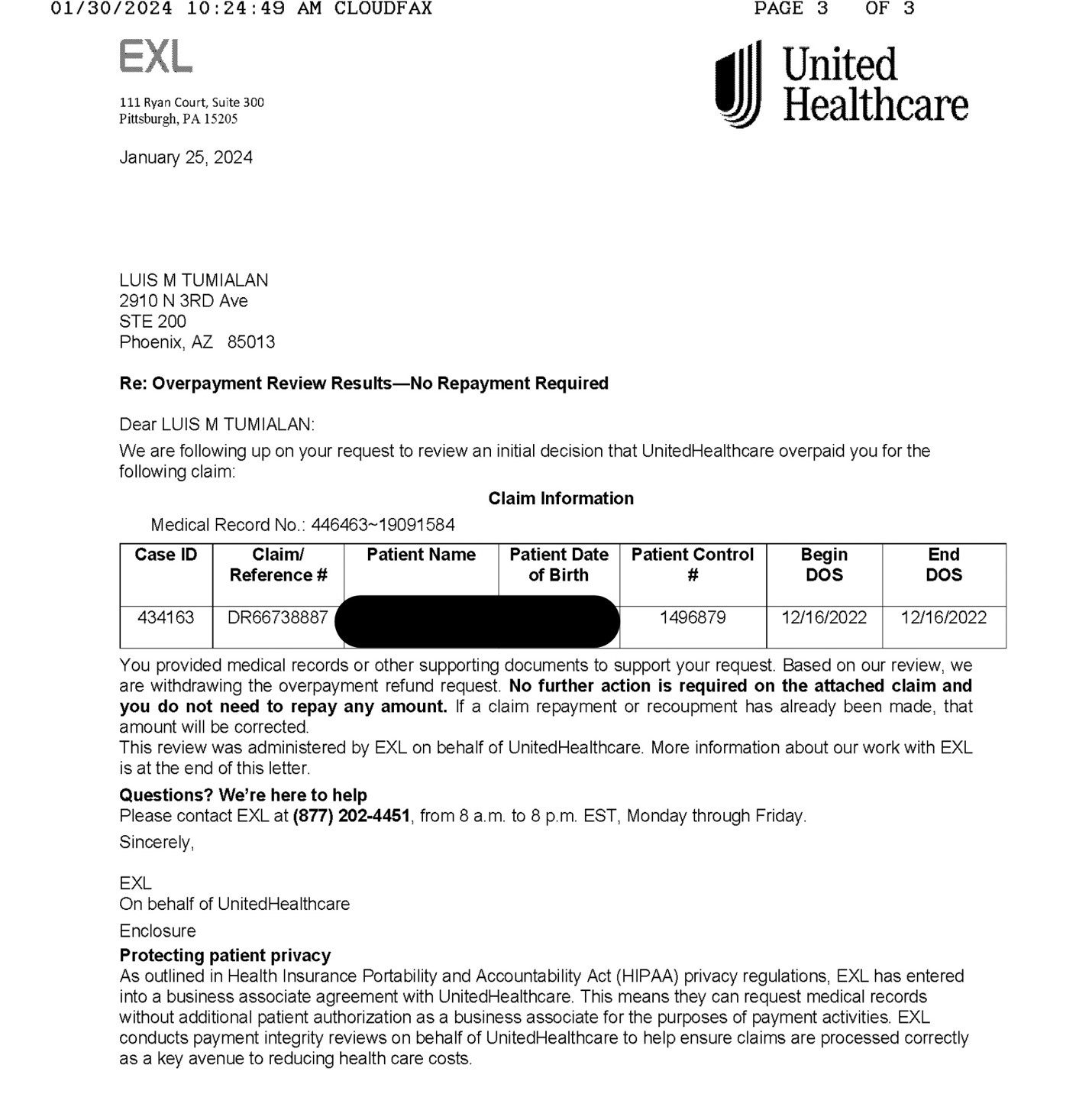
The next phase of this tale is recovering the recoupment. The process of appeals is long and onerous. I decided to determine whether a recoupment is recoverable and see it through to the end. The odyssey that my staff and I went through could fill a small novel. The introduction of a third party into the recoupment process facilitates plausible deniability for timely repayment by the commercial payer. The commercial payer would assign responsibility for the next step to the third party. The third party would, in turn, explain that they do not issue refunds, just the recommendation on repayment. No one could provide us the ability to place both parties in the same communication because all correspondence requires use of portals. The result is a vicious cycle of email exchanges without closure but a promissory note “we are doing our best to resolve this issue for you.” In this circumstance, a relentless pursuit of repayment still required 14 months. The effort for collection for one account is untenable for a business office that is already mired in prior authorizations and pursuing payment denials. Add the stealthy recoupment to the list of potential revenue losses, and the business office personnel are now stretched beyond their ability to cope.
What can be done? There are immediate actions we can take and aspirational long-term ones as well. The first step is to make your staff aware that commercial insurers have hired third parties. These third parties send letters via the U.S. Postal Service, which can easily escape notice. We need to train our staff to identify these communications and take immediate action on the request of records. The second step is to quantify the number of recoupments. Remember, if the letters go unanswered, funds are being subtracted from subsequent payments. Your practice is not actively writing a check, it is passively losing revenue.
Aspirational steps involve legislative changes to the practice of recoupment. Legislation that requires commercial insurers to bill the provider instead of subtracting a recoupment from a subsequent payment changes the landscape entirely. No longer would these recoupments be able to slither imperceptibly through your business office hidden among the tall grass of a larger payment. Secondly, the request for the entire medical record is intentionally and obtrusively overbearing. The entire medical record is not needed to confirm a procedure was performed. If confirmation of the procedure is truly the goal, only one document is needed: the operative note.
One thing is certain: the practice of recoupment should be no more of an issue in the practice in neurosurgery than it is in the world of construction. A general contractor would never tolerate such a business practice nor should we as neurosurgeons.


Dr. Tumialán is a neurosurgeon at Barrow Brain and Spine in Phoenix, Arizona. He is the Director of Minimally Invasive Spinal Surgery for the HonorHealth System. He is board certified by the American Board of Neurological Surgery. His expertise includes minimally invasive spine surgery and cervical and lumbar arthroplasty.