Apparently, I have a bone spur in my neck digging into a nerve. I have wicked arm pain. My hand is numb and my arm is weak. My surgeon has a plan to fix it. But my insurance does not like the plan. Instead, my insurance has told me I need some dead guy’s bone in my neck instead of a state-of-the-art implant for my cervical surgery.
News to me.
Up until recently I had believed—naively, perhaps—that the contents of my neck were my business, my surgeon’s business and maybe God’s business if He was feeling supervisory that day. But it turns out there is another interested party in the matter of my cervical vertebrae: an insurance company headquartered somewhere far away from my neck.
Aetna has taken a position.
My surgeon recommended a PEEK cage implant. It is a small, very modern and very exact device designed to hold two vertebrae apart in a perfect lordotic position while bone grows between them after removal of this God-awful bone spur. The PEEK implant is precisely engineered, measured and consistent. It’s the sort of thing that looks like it came out of a spaceship toolbox.
But Aetna has studied the situation very carefully—from what I assume is a cubicle—and determined that what I actually need is a chunk of cadaver bone.
My story is not a metaphor. We are talking about an actual bone. From a person who used to have it. He or she is now dead. I would like to pause here to acknowledge the generosity of the deceased. Truly admirable. But it still seems strange that a corporation has decided the deceased’s now unemployed bone is the correct interior decorating choice for my cervical spine.
My surgeon explained it politely. Surgeons are polite when they have to explain things that make no earthly sense.
“The insurance company didn’t approve the implant,” he said with a resigned shrug. He clearly has been through such a denial before. He looked pathetically powerless. I believe the term is learned helplessness.
But the entire approval process is still new and fascinating to me, mostly because it’s my body. The process is also beguiling because the insurance company will not be present during my surgery. They will not be holding the scalpel. They will not be the ones trying to get my vertebrae to behave themselves. They will not even be in the room unless they plan to dial in via speakerphone. And we all know they won’t do that. We all know they don’t really care about me. They only care about making sure that I send in my premium payment on time, or they won’t pay for darn thing. Not even the cadaver bone.
Yet Aetna still has opinions about what goes inside my neck. Apparently, the folks at Aetna believe the cadaver bone is perfectly adequate. After all, Aetna’s medical advisory group (who seemingly are a group of spine surgeons who no longer perform any spine surgery) say the fancy implant has not been proven “more effective.” What does that mean? I can also say that airplanes have not been proven more effective than walking, because both eventually get you somewhere.
The implant my surgeon recommended is made of PEEK—polyetheretherketone. That’s a word so advanced it sounds like a secret code word astronauts use when they’re bored.
The material is engineered to behave like bone. It’s strong, consistent, sterile and designed specifically for the job. It doesn’t crack because it had a bad day in 1974. It doesn’t come with mysterious life stories, like a history of venereal diseases from youthful years of unbridled freedom. Or tuberculosis. In the world of spine, PEEK has been used for the last two to three decades. But still Aetna calls it, “experimental and not medically necessary” and so they won’t pay for it. After a quarter century of use, can anything be still called experimental? Maybe they really mean “expensive and not medically as needed as saving money.”
But the cadaver bone has advantages too, I suppose. It’s nostalgic. Vintage. Organic. Low carbon footprint. It’s like recycling…kind of. Why put bones in the ground when you can put them in my neck? Perhaps Aetna is simply committed to traditional craftsmanship. Maybe somewhere in their policy manual there’s a romantic paragraph about how modern medicine has lost touch with the artisanal roots of spinal surgery. Conceivably they imagine surgeons standing around a wooden workbench selecting the finest heirloom vertebral timber. “Ah yes,” the old surgeons might say with their smocks on. “This one right here pairs beautifully with the cervical spine.” Imagine that sentence uttered with a strong Scottish accent.
My beleaguered surgeon mentioned to me that every other commercial insurer and even Medicare would approve the implant. Apparently, Aetna stands alone in its conviction that what my neck truly needs is a souvenir from the bone bank. It might be time for me to switch insurances. But I cannot wait 10 years for Medicare eligibility. My arm hurts too much. What month is open enrollment?
So here I am with a painful numb arm, a bone spur and a denial. Aetna has me over a barrel. The surgeon recommended implant versus insurance approved one puts me in an interesting philosophical situation.
When an insurance company denies a surgeon recommended implant and approves a cadaver graft instead, they are doing something quite extraordinary: they are deciding what materials are allowed to exist inside my body. I am no longer part of that decision because my employer’s choice in commercial carrier. What are the chances?
Making that decision is a bold hobby for an accounting department. I can only imagine the meeting where this decision was made. A long conference table. The scent of burnt coffee. Some donuts. Folks cutting those donuts in half thinking they are being healthy. A PowerPoint slide entitled “Neck Stuff.” Someone raises their hand. “What if we just made the patient use a bone from a dead person?”
Another person nods thoughtfully as they finish the half donut.
“Yes, excellent. That will save us a lot of money!”
And thus, my spinal destiny was determined right then and there.
My surgeon, who actually went to medical school, completed a residency and then a fellowship finds this slightly odd. He mentioned that implants like the one he recommended are widely used and engineered for predictable outcomes. But predictability may not be as exciting as cadaver roulette.
Every cadaver bone is unique, I’m told. Some are perfect. Some are brittle. Some crack. Some come from donors who probably never imagined they would one day be participating in my cervical fusion.
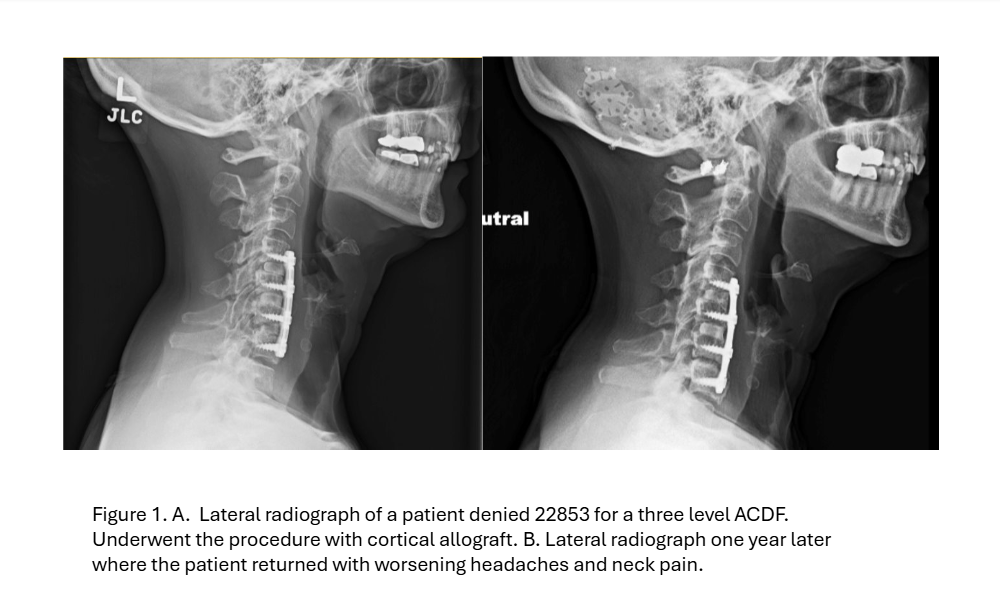
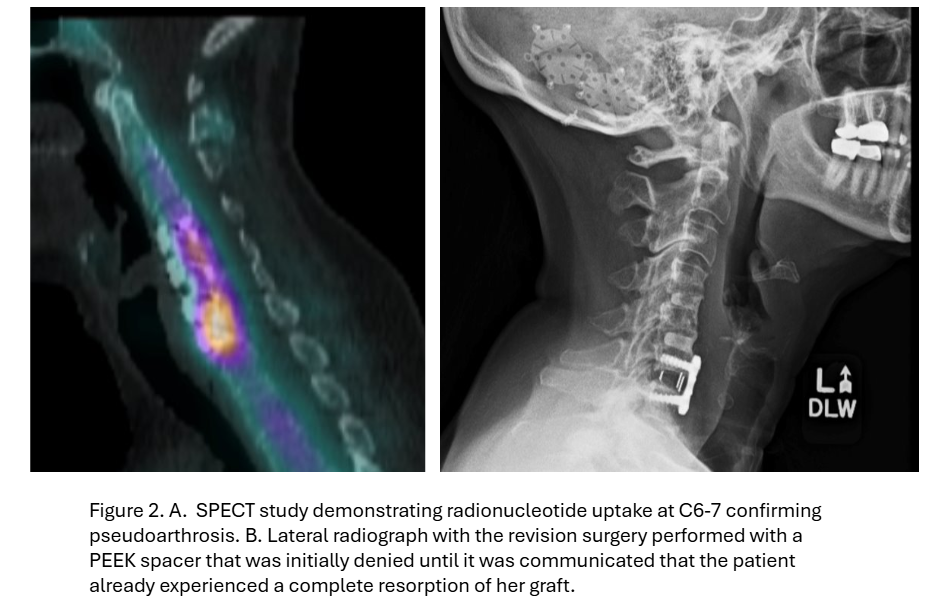
“Will it work?” I asked my surgeon. “Most of the time,” he told me. “What about the other time?” I asked. “Sometimes the bone can dissolve like a lifesaver in your mouth,” he said. “Then what?” I ask. “Then we do it over again with PEEK, which won’t dissolve,” he said. I looked at him and then he looked at me. Then we just looked at each other for a long time.
So here I am, waiting for surgery with killer arm pain, contemplating the fact that somewhere out there is an Aetna policy stating what parts of other people are acceptable substitutes for modern medical devices so an insurance company can save a lot of money. Or just pay out a huge bonus for their CEO. ($18 million in 2024.)
What a curious system. The people who know the most about spines recommend one thing. The people who know the most about insurance spreadsheets recommend another. Guess who wins. I suppose I should be grateful. At least Aetna hasn’t started choosing my breakfast cereal yet.
Though given enough time, I suspect they will. For now, Aetna has decided that my neck requires a small piece of someone who is no longer using it.
And maybe that’s fine. Maybe it will work perfectly. Maybe the bone will fuse and my spine will behave and we will all live happily ever after. But I can’t help noticing something strange about the arrangement. The surgeon will operate. The cadaver will donate. My arm pain will go away. I will recover (I hope!) And Aetna—having successfully chosen the contents of my neck—will move on to deciding what goes in someone else’s. And writing bonus checks for their CEO with contributions from my on time premium payments. Unless I switch insurances.
What month is open enrollment again?


Dr. Tumialán is a neurosurgeon at Barrow Brain and Spine in Phoenix, Arizona. He is the Director of Minimally Invasive Spinal Surgery for the HonorHealth System. He is board certified by the American Board of Neurological Surgery. His expertise includes minimally invasive spine surgery and cervical and lumbar arthroplasty.