The relationship between a patient and physician is the foundation of medical practice. From routine primary care wellness visits to the unexpected emergency room evaluation, patients place their trust into physicians. In the setting of spine surgery, a unique relationship forms between patients and spine surgeons as they navigate an array of issues, including debilitating neck and back pain, devastating spinal cord injuries and life-threatening tumors. Patients put their faith in us at their most vulnerable state searching for answers. It is in these critical moments that we partner with our patients to walk the road together, to listen, to act and to heal. We build the crucial trust that allows the patient and the surgeon to navigate the existing challenge as a unit, engaging in shared decision making and embarking on the journey ahead as a team.
However, there is a reality in today’s version of medicine that adds a third party to the patient-physician relationship. Healthcare insurers are increasingly intruding in the care of our patients. Though insurance companies have an important role in promoting responsible resource utilization, insurance coverage policies are increasingly overriding surgeon judgment and shared clinical decision making by mandating what devices and implants should or should not be used. By doing so, insurers cross a nebulous line from supporting patient care to dictating medical practice. As insurance-driven medical decision making perpetuates throughout the United States, the patient-physician relationship takes a secondary role, leaving the door open to unfavorable and avoidable patient outcomes. A recent case involving cervical spine surgery highlights the significant patient safety risks that can arise when misguided coverage policies prevent surgeons from carrying out a surgical plan they believe is most appropriate for their patient.
A Preventable Revision Surgery
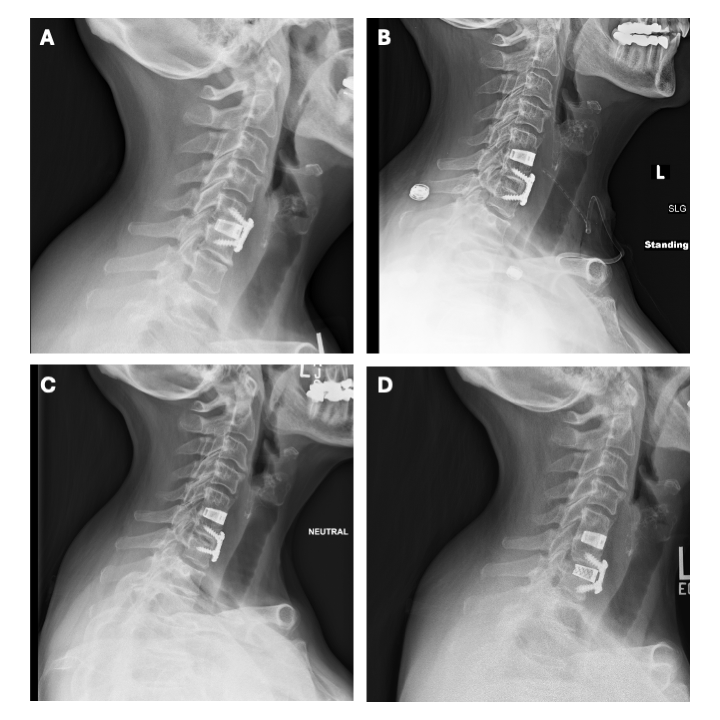
Consider the patient in figure 1 who had a prior C5-6 anterior cervical discectomy and fusion (ACDF) several years prior with a titanium interbody spacer. Years later, the patient developed adjacent segment disease at C6-7, a common problem in which degeneration develops at the level next to a prior fusion. The surgeon recommended a titanium interbody spacer again, which is not an experimental device or an unproven concept. Interbody devices have been used in cervical spine surgery for a quarter century to restore disc height, maintain alignment, provide structural support and facilitate fusion. However, the patient’s insurer would not cover the planned biomechanical interbody device. The surgery would only be approved if structural cadaveric allograft was used instead.
Faced with the choice of delaying treatment or proceeding with a less desirable option, the patient underwent surgery using the insurer-mandated allograft. Within three months, the structural graft resorbed and lost the structural integrity needed to maintain the fusion construct. The patient required revision surgery. Ultimately, the patient received the titanium interbody spacer that the surgeon recommended from the start. This is a narrative of a pseudoarthrosis is not simply a story about a failed graft. It is a story about a patient undergoing an avoidable second operation because a coverage policy overrode individualized medical judgment.
This case poses a fundamental question: Who should make surgical decisions for patients, the treating surgeon, or the insurance company?
Insurance companies seek to verify that technologies provide meaningful clinical value before agreeing to reimburse for them. However, coverage policies often lag behind contemporary clinical practice and may fail to account for evolving evidence, advances in implant design and individual patient factors. When rigid policies prohibit surgeons from selecting implants they believe are medically appropriate, patients may become the unintended victims of insurer decision-making. Surgical decision-making is nuanced and depends upon numerous patient-specific factors that cannot be captured by broad administrative policies. It is the surgeon’s holistic evaluation of the patient, review of imaging studies, careful consideration of risk factors and extensive discussion of treatment options with the patient that make them the most qualified person to determine the appropriate implant. One-size-fits-all mandates remove surgeon discretion and experience at the cost of patient outcomes.
Modern interbody spacers have become widely adopted in cervical fusion procedures and have proven to provide immediate structural support, resist collapse and resorption and can facilitate fusion through porous designs that encourage bone growth. Their use has been shown to be safe and yield similar, and in many cases, superior outcomes compared to cadaveric allografts [1-4]. Thus, their indications should be primarily dictated by the surgeons themselves as they abide by practicing evidence-based medicine.
When surgical decision-making is taken away from surgeons in instances like these, the consequences of such coverage restrictions extend beyond individual patients. Revision spine surgery is substantially more expensive, often requiring longer operative time, greater resource utilization, more complex postoperative care and increased risk of complications [5, 6]. Prior studies have demonstrated that pseudarthrosis and construct failure remain major drivers of revision ACDF surgery, as in the insurer directed care presented above [7].
Moreover, coverage policies that force the hands of surgeons in using implants and devices they would not otherwise select create a troubling ethical dilemma. The aforementioned patient-physician relationship is essential. How could a surgeon proceed with implantation of an inferior or inappropriate alternative device while knowing the best option is available but simply not covered? When insurers deny coverage, surgeons are forced to practice second-best medicine that is driven by the insurance companies’ financial outcomes, rather than standard of care medicine that is focused on patient outcomes. This troubling reality highlights a compromise driven by reimbursement policy rather than medical judgment.
A recent multi-society position statement, endorsed by the leading organizations in spine surgery, concluded that interbody biomechanical devices should be recognized as medically necessary and reimbursable in anterior cervical fusion procedures. The statement emphasizes that patient safety is best served when surgeons and patients can jointly select among structural autograft, allograft and biomechanical devices based on the patient’s individual needs, preferences and the recommendation of the treating surgeon.[8] That is the standard that should guide coverage policy.
The pseudoarthrosis case herein is just one example of many demonstrating more than a story about a failed allograft. It illustrates a broader systemic issue in which administrative policies can supersede patient-specific medical decision-making. The result was entirely predictable: a patient underwent an avoidable second operation to receive the exact implant that had originally been recommended. Patient safety should remain at the pinnacle of any policy. Insurers should embody that same principle by creating coverage policies that reflect current clinical evidence and allow sufficient flexibility for surgeon-directed, patient-specific treatment decisions. Standard of care is not determined by an insurer’s coverage policy. Standard of care is determined by evidence-based practices driven by physicians as they seek to serve and tirelessly advocate for their patients. Standard of care is not about “surgeon preference” or increasing surgeon reimbursements. Standard of care is about doing the right thing for our patients. Medicine should not be practiced by an insurer behind a computer. Instead, we should practice medicine with the patient-physician relationship as our North Star. That relationship is, after all, the utmost foundation of medical practice.
References
1. Kim CH, et al. Which interbody device minimized nonunion, subsidence, and revision surgery after anterior cervical discectomy and fusion? Journal of Neurosurgery: Spine. 2024.
2. D’Antonio N, et al. Structural allograft versus PEEK and titanium alloy cages: pseudarthrosis and outcomes after ACDF. Asian Spine Journal. 2023.
3. Jain A, et al. Structural Allograft Versus Mechanical Interbody Devices Augmented With Osteobiologics for ACDF: A Systematic Review. Global Spine Journal. 2024.
4. Mayer F, et al. Radiological and Clinical Outcomes after ACDF Using a 3D-Printed Titanium Cage. Brain Sciences. 2022.
5. Yee, T. J., Swong, K., & Park, P. (2020). Complications of anterior cervical spine surgery: a systematic review of the literature. Journal of spine surgery, 6(1), 302.
6. Pennington, Z., Mehta, V. A., Lubelski, D., Elliott, C., Miller, J. A., Benzel, E. C., & Mroz, T. E. (2020). Quality of life and cost implications of pseudarthrosis after anterior cervical discectomy and fusion and its subsequent revision surgery. World neurosurgery, 133, e592-e599.
7. Menon N, et al. Structural Allograft Versus Synthetic Interbody Cage for ACDF: Analysis of Revision Surgery and Outcomes. Neurospine. 2020.
8. Position Statement on Insurance Coverage for Interbody Biomechanical Devices (CPT 22853) in Cervical Spine Arthrodesis. Endorsed by the American Association of Neurological Surgeons, Congress of Neurological Surgeons, AANS/CNS Section on Disorders of the Spine and Peripheral Nerves, American Academy of Orthopaedic Surgeons, Cervical Spine Research Society, International Society for the Advancement of Spine Surgery, North American Spine Society, Scoliosis Research Society, and Society for Minimally Invasive Spine Surgery.
Figure 1 Legend
A- Postoperative X-ray of the cervical spine following the patient’s initial surgery at C5-6 in 2021 utilizing a titanium interbody. B- Immediate postoperative X-ray after surgical revision and C6-7 ACDF in 2024 with the use of allograft. C- 3-month postoperative X-ray revealing allograft resorption and construct failure at C6-7. D- Postoperative X-ray following surgical revision and conversion to the originally proposed titanium interbody device at C6-7.


Matheus P. Pereira, MD
Anisse Chaker, MD
Brian F. Saway, MD