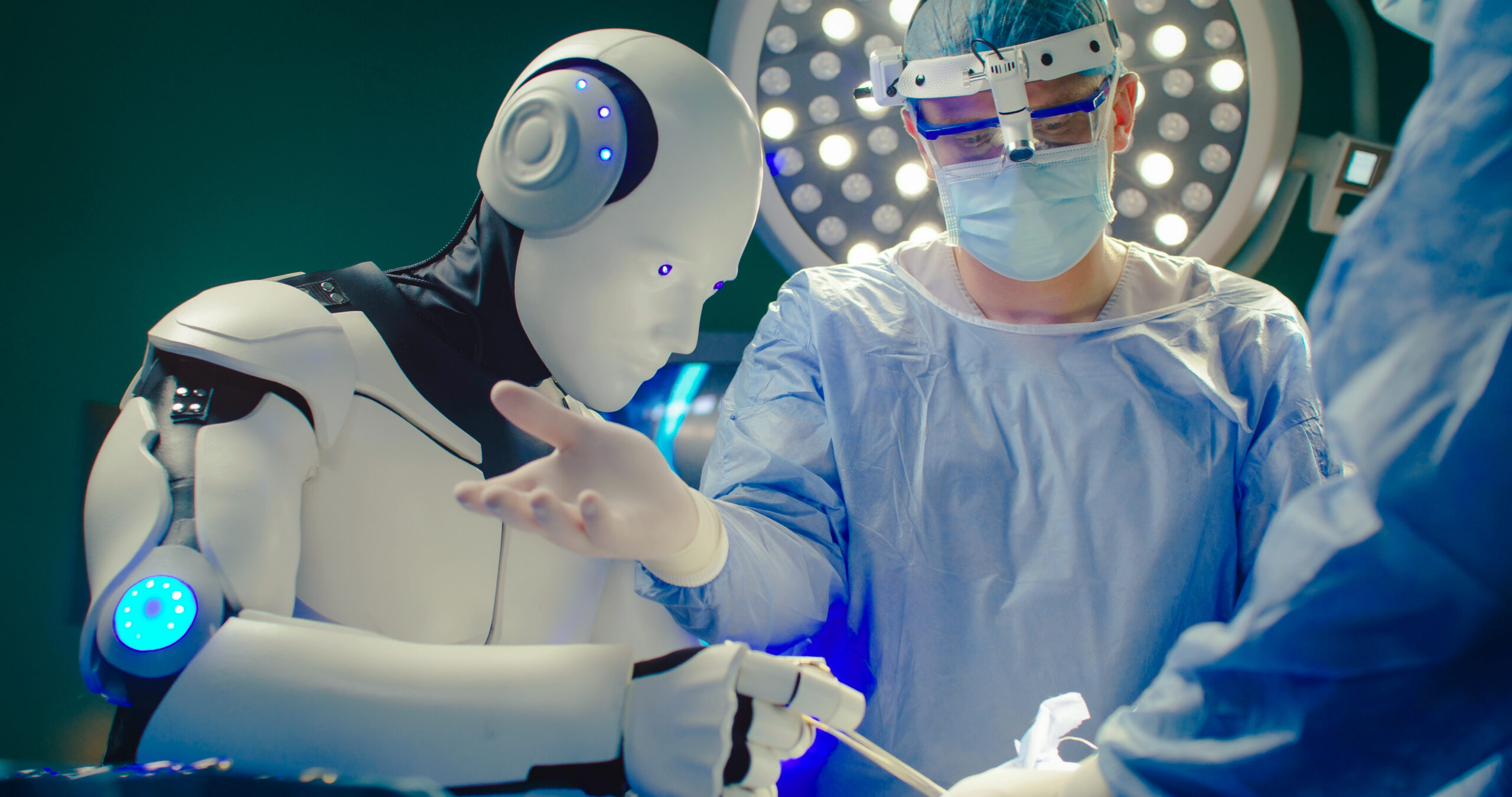
In the unabating pursuit to improve patient care and outcomes in the field of neurosurgery, revolutionary advances in artificial intelligence and its potential contributions are undeniable. However, there are significant challenges and implications in the utilization of AI that are worthy of discussion and should be at the forefront of this ongoing conversation. The principal concerns regarding integration of AI into health care and neurosurgery include the privacy and security of data, error and bias within data, transparency of algorithms, limitations in adaptability, overreliance of surgeons, loss of human touch and ethical and legal implications.
Privacy and Security
The development of AI systems in health care requires the construction of complex, clinically functional algorithms. Immense sets of patient data are needed to create and train the algorithm to respond to the myriad and diverse clinical scenarios it will encounter. Creation of a comprehensive algorithm requires the sharing of data across institutions, the country and ideally, the world. The dissemination of sensitive patient information poses serious security risks that cannot be ignored. This includes potential breaches of confidentiality and privacy, cyber-attacks and misuse of data. Therefore, a dilemma exists between a need for unhindered data access for optimization of the algorithmic accuracy and efficacy in AI versus the need for patient privacy. The safe development and integration of AI into health care necessitates addressing these contrasting obligations.
Error and Bias in Data
The algorithms developed for AI are also susceptible to error and bias which can significantly impact safety and accuracy. Incomplete, inaccurate or biased data that is used in algorithm development and training will result is a similarly flawed system; this may lead to harmful and disparate outcomes.
Lack of Transparency
Another dilemma in the integration of AI in neurosurgery is the lack of transparency known as the “algorithmic black box.” Neurosurgeons are trained to be highly analytical and critical because it results in the most thoughtful care and optimal patient outcomes. The use of a particular drug, product, imaging modality, device or process requires that a neurosurgeon thoroughly understands how it works. The process used to build AI algorithms is often a mystery to the user. For the neurosurgeon, a lack of understanding of AI’s processes may lead to difficulty in implicitly utilizing its guidance.
Limitation in Adaptability
While emerging AI systems are trained to be flexible and adaptable, they will likely never match the resourcefulness of a human. The AI algorithms are formulated from sets of data that are predominantly standard patient scenarios and anatomy, but their ability to pivot in the face of an unexpected or anomalous presentation is inferior to our capabilities. This is known as the “frame problem,” wherein the AI system is dependent on standard logic and may be unable to identify the appropriate or relevant data in an unfamiliar scenario. This could result in errors and detrimental actions taken by AI that are not in the best interest of the patient or surgeon.
Overreliance of Surgeons
A potentially detrimental downstream effect of incorporating AI into neurosurgery is overreliance of surgeons resulting in a decrement in clinical and surgical acumen within our field. As clinical and technical tasks are reassigned to AI, the personal development, maturation and honing of these skills could be stunted in surgeons. A surgeon’s dependence on AI will inevitably lead to an inability to identify and adjudicate malfunction or technical errors made by these computers. It will be imperative that we mitigate this risk by maintaining our expertise, judgement and control over our clinical decision making and operating rooms and remembering that AI is meant to augment, not replace, skilled neurosurgeons.
Loss of the Human Touch
The seemingly boundless capabilities and potential of AI are magnificent, but they are inferior to the human touch in many ways. The human touch encompasses compassion, judgement, intuition, conscience, wisdom, abstract thought, and haptic feedback; these qualities cannot be matched or replaced by computers (10,11,14). Patients entrust their neurosurgeon to care for and protect them, not a computer. Palmisciano et al. reported that the majority of patients and families are accepting of the role and utility of AI in neurosurgerybut ultimately want the neurosurgeon to remain in control 13. The importance of the patient-doctor relationship and the profound impact of human touch cannot be forgotten in the advancement of AI within the neurosurgical field 12.
Ethical Implications
The ethical implications of AI within healthcare should be measured and made transparent, specifically with regards to accountability and liability. If there is an error in the underlying AI algorithm that leads to a mistake in diagnosis, clinical decision making, or surgical procedure, to whom is the responsibility assigned? While the surgeon was not involved in the creation and training of the underlying algorithm, the responsibility will likely fall on their shoulders and not those of the programmer or manufacturer 2,3. Investigation into the ethical implications of AI utilization and the potential risk and legal exposure that neurosurgeons will face should be a priority.
All innovation within neurosurgery should be met with mixture of excitement and critique, and we should approach AI similarly. While AI is an impressive field of computer science and holds great promise within healthcare, neurosurgeons should evaluate the potential benefits and risks of AI in the same dogged, passionate, and analytical way that we approach all of our neurosurgical decisions.


Cara Rogers, DO, FAANS, is a neurosurgical oncologist in Roanoke, Virginia. After residency training at Virginia Tech, and a neurosurgical oncology fellowship at MD Anderson, she joined the faculty in the department of neurosurgery at Virginia Tech Carilion and is an assistant professor at the Virginia Tech Carilion School of Medicine.