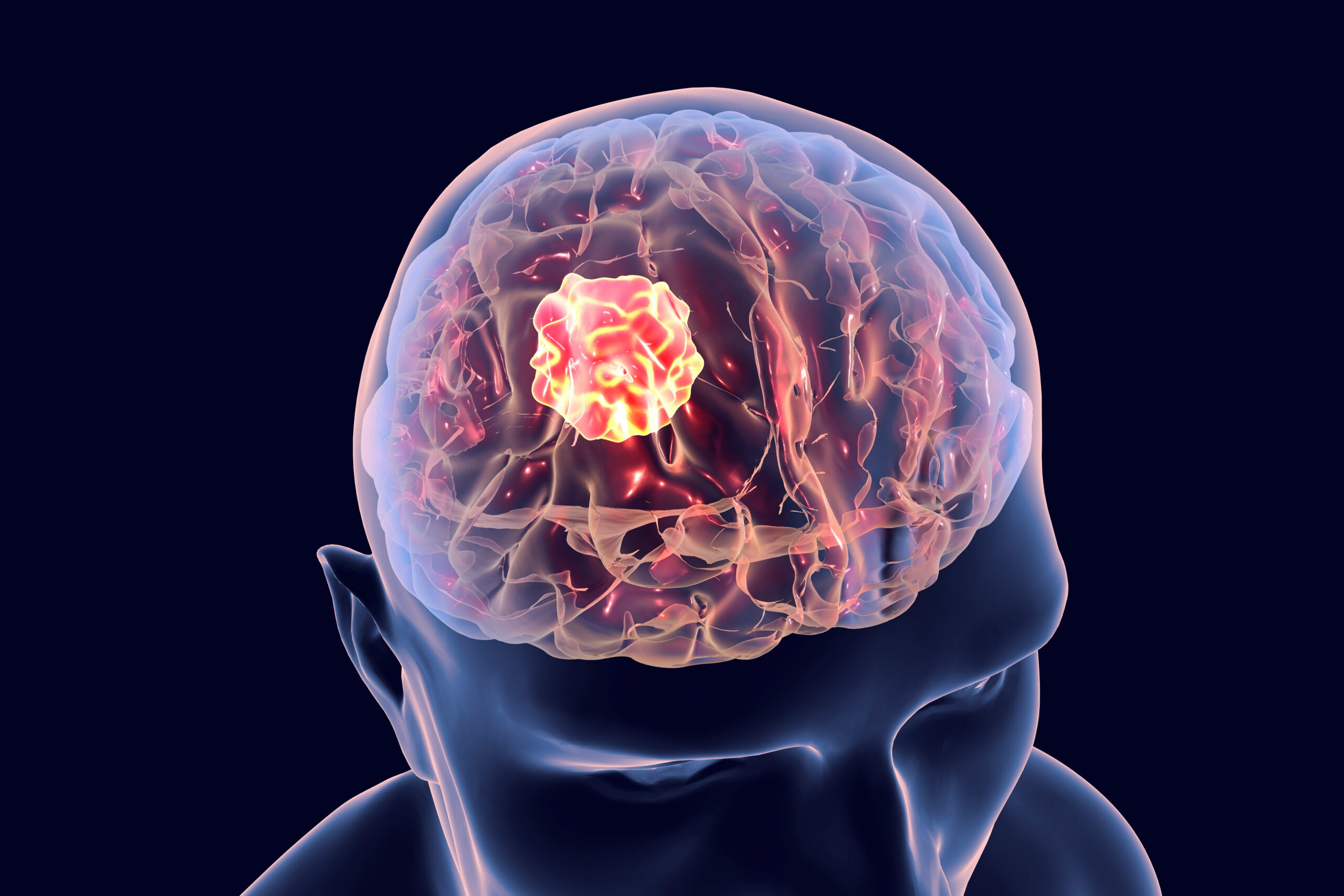
Outcomes for patients with malignant brain tumors are divided into either clinical outcomes (COs) or patient-reported outcomes (PROs). Clinical outcomes are measured by the physicians or their staff and define physical, anatomic or performance attributes. Patient-reported outcomes address the functional and psychosocial results of care and Quality of Life (QoL) through the patients’ eyes. Over the past 40 years, an extensive set of measurements has been available to assess outcomes, with an increased focus in recent years on PROs, including QoL assessments.
The safe resection of tumors has improved over the past 40 years with the advent of MRI scanning, neuro-navigation, functional brain mapping before and during surgery and Laser Interstitial Thermal Therapy (LITT). Mortality, and especially morbidity, have decreased as a result, even as surgical treatment has become more aggressive with the understanding that maximum tumor extent of resection (EOR) independently influences overall survival (OS).
Previously, the primary clinical outcome measures have been mortality and neurological morbidity. Performance status has been quantified by the Karnofsky Performance Status (KPS) and Eastern Cooperative Oncology Group (ECOG) scales. Tumor size measurements are recorded as response rates (CR, SR, SD, PD), after consideration of possible confounding factors such as pseudo-progression, radiation necrosis and treatment effects on contrast-enhancement alone. Progression-free survival (PFS) and time to tumor progression (TTP) have been utilized as a measures of therapy efficacy; the most accepted measure of therapeutic efficacy has been OS, in part because of ease of measurement. However, OS does not account for quality of life.
There is a tremendous difference between patients with very poor QoL and those living a healthy, enjoyable and happy life, even if survival is the same. As Hartzband and Groopman told us “…basing decisions on the outcome of death ignores vital dimensions of life that are not easily quantified”. Since the 1980s, much effort has been made on developing measures of PRO and QoL, such as NIH PROMIS (Patient Reported Outcomes Information System), SF-36/12, EQ-5D, EORTC QLQ-30 and -BN20, FACT-G and-BR, so that QoL can be quantified.
We encourage the development of a new measure of survival based on QoL. Quantifying QoL scores at intervals during a patient’s care can identify when scores diminish into a significantly disabled state. This state would be defined differently for each available QoL measure but could be standardized for analytic purposes. The time before that state would be identified as a measure of Quality Survival (QS). Although individuals could interpret “quality existence” differently, it would be most useful if a common value would be registered as the time limit for defining QS.
Beyond assessment of COs and QoL, it is also important to understand the process of care “through the patient’s eyes”. Recently, the NeuroPoint Alliance has developed a Quality Outcomes Database (QOD) Tumor Registry that collects outcome data from routine clinical care. However, to date there does not appear to be a brain tumor-specific survey that focuses on patients’ experience of care. We propose such a survey to improve patients’ care both at the time of the initial diagnosis and throughout their care.
Most patients experience emotional episodes both when initially diagnosed and during their subsequent treatment. We propose the development of a Patient Experience Satisfaction Survey (PESS) that directly addresses whether the care team has utilized methods to minimize those crises.
The period of initial diagnosis can be described as a “crisis of shock and the unknown”. Our patients encourage the following strategies for effective communication:
- Demonstrate a caring and empathetic attitude.
- Assess and clarify the patient’s understanding of the situation.
- Communicate honestly and compassionately in a manner they can understand.
- Calm fears and emphasize that every patient is unique and prognoses are averages and dynamic.
- Discuss the science and provide hope for the future.
- Provide time to answer questions and assure understanding.
- Describe the process of care and develop a relationship between your committed care team and the patient and family.
During treatment, four challenging timepoints exist:
- While awaiting results of imaging studies, patients experience a “crisis of anticipation.”
- At the documented failure of the initial treatment program, there is often a “crisis of defeat and limitations.”
- With disabling deficits or intolerable therapy toxicity, there occurs a “crisis of diminishing QoL.”
- When QoL deteriorates in the terminal period, patients experience a “crisis of terminal expectation and limited legacy.”
Strategies to deal with the above include the following:
- Communication of results should occur on the day when imaging studies are completed. Results should be communicated by direct consultation or through digital portals with a personal discussion available without delay.
- When initial therapy fails, the team should offer access to clinical trials at the home or outside institution.
- When disabling deficits occur or if therapies result in significant toxicity, patients should be provided adequate symptom relief by the treating teams and/or be referred to Palliative Care.
- When all attempts fail and QoL deteriorates, hospice referral should be offered. Communication should continue with the primary care team to avoid patients’ feeling abandoned.
Patient satisfaction in regard to these 11 aspects of care should be assessed. This Patient Experience Satisfaction Survey (PESS) should provide feedback to the care team for process improvement.
Taken together, regular, formal assessment of “Quality Survival” as well as the “Patient Experience Satisfaction Survey” could become a tangible additional sign of our neurosurgery’s commitment to the highest-quality care for its patients.


Mark L. Rosenblum, MF, FAANS, is the chair emeritus of the Department of Neurosurgery in the Henry Ford Health System (HFHS) where he developed a department of 32 physicians and scientists that was nationally recognized for research and clinical excellence by US News and World Reports(14/15 years). There, he founded and served as co-director of the nationally recognized Hermelin Brain Tumor Center (National Cancer Institute(NCI), 21 years) and the HFHS Neuroscience Institute (SG2 and NeuroSource, 18 years). He also was one of 4 leaders that developed a new patient-focused Henry Ford West Bloomfield Hospital where he served as vice president of Clinical Programs and director of its Center for Health Services Transformation.

Co Director Hermelin Brain Tumor Center at Henry Ford Health System.

Allen S. Lichter, MD, served as the chief executive officer of the American Society of Clinical Oncology and Conquer Cancer, the ASCO Foundation from 2006-2016. He has been an ASCO member since 1980 and served the society in an array of volunteer capacities before accepting the position of CEO in 2006. Dr. Lichter’s research and development of three-dimensional treatment planning led to a Gold Medal from the American Society for Radiation Oncology. In 2002, he was elected to membership in the Institute of Medicine of the National Academies of Science.
Adam Robin, MD, FAANS, is a neurosurgeon in Detroit, Michigan. He is affiliated with Henry Ford Hospital.

David Nerenz, PhD, is director emeritus of the Center for Health Policy and Health Services Research at Henry Ford Health in Detroit. His research interests have been primarily in the areas of quality-of-care measurement and racial/ethnic disparities in quality of care. He is currently helping to lead two statewide quality improvement initiatives in Michigan, one in spine surgery and one in lower-back pain. He has served recently as co-chair of the National Quality Forum's Scientific Methods Panel and served as a MedPAC Commissioner from 2012 to 2018.